I'm going to try publishing this blog on Substack; please go here to see new posts and an archive of all of my older posts. I'll have a great new interview of Gregor Tassie up soon.
Friday, January 20, 2023
Monday, January 2, 2023
Gavriil Popov: An electronic music pioneer?

A few days ago, I purchased the above album from Presto Music (a site that has a good selection of classical music, suitable for filling in some gaps in my collection) and I've listened to the recording several times. When I paid attention to the first piece in the suite, I thought, "Is that a theremin?"
Gavriil Popov's Symphonic Suite No. 1 dates from 1933 and was derived from film music. A theremin is an electronic instrument, dating from 1928.
So I ran a search, and here's the answer to my question, from Laurel Fay: "Appropriately, the performance features a theremin, an electronic instrument invented in Russia in the 1920s by Lev Termen (1896-1993). In his score, Popov offset the futuristic sound of the 'electric' theremin with the 'human' voices of a soprano and tenor." And here is another article.
The use of electronics alongside regular acoustic symphonic instruments is no longer startling; this Wikipedia piece on Finnish composer Kaija Saariaho notes, "Her work in the 1980s and 1990s was marked by an emphasis on timbre and the use of electronics alongside traditional instruments."
But Popov's piece dates to the early 1930s. Wouldn't the use of an electronic instrument in a "serious" composition back then be unusual and pioneering? Is there an earlier example?
Thursday, December 1, 2022
Review: Gregor Tassie's 'Three Apostles of Russian Music'

The Three Apostles of Russian Music: The Soviet Avant-Garde, Gregor Tassie, Lexington Books.
I started this blog because I had discovered that I not only loved Prokofiev and Shostakovich, I also loved their lesser-known, very talented but persecuted colleagues, such as Nikolai Roslavets, Gavriil Popov and Alexander Mosolov. I was determined to do what I could to help others discover these composers.
Scottish musicologist Gregor Tassie must feel much the same way. His book, The Three Apostles of Russian Music: The Soviet Avant-Garde, discusses Roslavets, Popov and Mosolov, covering their most important works and providing context about their lives and work, including their 1920s and early 1930s heyday.
Tassie previously authored a biography of Nikolai Myaskovsky and of two prominent Russian musicians, the conductors Yevgeny Mravinsky and Kirill Kondashin. The biography at the back of his new book states teasingly that he's now at work on a biography about "a celebrated Russian musician." He apparently speaks fluent Russian, allowing him to quiz Russian college professors who are experts on the trio he writes about and to dig through primary source archives.
The result is a book that is heavily researched and a wonderful resource for fans of Russian avant-garde classical music of the last century. Fans of Prokofiev and Shostakovich also will learn much by finding out more about the milieu of the two best-known Russian composers.
Tassie is careful to tell the reader which of the men's works are particularly good and deserve close attention; his judgment generally seems quite sound to me (i.e., I often found myself agreeing with him.) For example, when I recently listened to a recording by the German group Trio Fontenay of Roslavets' surviving piano trio works, I noticed that I particularly liked the third trio. Tassie refers to it as an "outstanding piece."
Indeed, readers will want to pay careful attention to sentences such as this one, about Roslavets' Chamber Symphony No. 2: "In the context of symphonic works written during the 1930s, Roslavets's symphony justifiably stands with Popov's First (1934), Shostakovich's Fourth (1936), and Myaskovsky's Tenth and Seventeenth (1930)."
Many of the composers Tassie writes about were particularly edgy early in their careers but adopted a more conservative approach in their later years, and Tassie is careful to note that these changes in direction weren't solely because of pressure from the Stalinist regime. Prokofiev, for example, was already moving toward a more approachable style before he returned to live in Russia. And Shostakovich, Tassie notes, showed signs of toning down his style even before the infamous attack in the pages of Pravda.
While Tassie obviously admires the composers he writes about, he also points out their failings. Popov is depicted as indolent, slow to finish his work and prone to missing deadlines. Mosolov was very careless about preserving his work. And in fact, it's sad how much music has been lost or is in jeopardy. Many of the works of the three composers have been sitting in archives for years and are only known through the efforts of dedicated Russian musicologists, who are named in Tassie's "Acknowledgements."
A careful reader will want to keep an eye not just on the text, but on the footnotes. For example, Tassie goes into considerable detail about Popov's film music, which allowed Popov to make a living when the composer got into trouble for "formalism," and at one point Tassie mentions a film director named Faintsimmer. The name meant nothing to me, but a note explains, "Alexander Mihailovich Faintsimmer (1906-1982) enjoyed a long career making his first movie in 1929 and notable for his 1934 film Lieutenant Kije with a score by Prokofiev, the suite from which became world famous."
As a kind of bonus, Tassie's final chapter discusses three more modernist Russian composers: Mikhail Matyushin, Arthur Lourié and Joseph Schillinger. The conclusion also puts Russian modernism in the context of global classical music modernism and touches on Russian composers who can be seen as successors to Tassie's trio.
The book includes a list of works for each composer and a list of recordings. Fortunately, as the trio continue to get more recordings, the list is already a bit out of date. The Popov Quartet Symphony, which Tassie apparently likes, finally got a recording.
This is a book aimed at the academic market and is unfortunately therefore rather expensive, so that perhaps some readers may have to resort to asking their local library to acquire it. That would also make the book available for others; good for Cleveland Public Library, where I found my copy, although (full disclosure) on the strength of this blog, the publisher agreed to let me have a review copy. I really wanted one; I am sure I will be referring to Tassie's excellent book many times.
Wednesday, November 16, 2022
Gavriil Popov's hard luck story

Film poster for She Defends the Motherland. Gavriil Popov wrote the score for the movie and recycled much of the music into his second symphony.
Is this one of the saddest stories in classical music, or one of the weirdest?
Imagine that you are best known for a very long first symphony. Except that after one performance, it was banned, and you never got to hear it again. There have been at least four recordings of your symphony -- not bad for an obscure composer -- but you never got to hear them, because they weren't made until years after your death.
I am referring to Gavriil Popov (1904-1972), one of the three Soviet composers featured in the new Gregor Tassie book, The Three Apostles of Russian Music, which I have not been so much reading as carefully devouring page by page.
I knew the outlines of the story about Popov's symphony, but Tassie fills in details. The symphony was premiered in 1935 to a "mostly hostile audience" and Popov noted in his diary that the symphony was under rehearsed and poorly performed. That was the last performance and the last time Popov got to hear an orchestra playing it. The score resurfaced a decade after Popov's death, according to Tassie.
That wasn't Popov's only bad experience. Tassie reveals that Popov had hoped to write the score for Eisenstein's Alexander Nevsky movie. Of course, Prokofiev got the job instead. Popov tried to write an opera about Nevsky instead but ran into numerous obstacles and was never able to finish it.
Tassie's book also has depressing passages about the two other composers he focuses upon, Nicolai Roslavets and Alexander Mosolov. Shostakovich and Prokofiev managed to largely survive the system, but Tassie's trio had their troubles. But they also had their successes, and Tassie writes about that, too.
I did feel somewhat better about Popov's journey after I read the section about him on Tassie's book. The fate of his first symphony is sad, but despite the ban and the criticism he received for being a "formalist," he continued his composing career. He made a living largely by writing film scores, often recycling the film music into his symphonies and other compositions. I listened again last night to his second symphony, the "Motherland," and it's a very enjoyable potboiler. It was a comeback symphony, akin to Shostakovich's Fifth, and Popov had great success with it, which he understandably enjoyed.
Friday, November 11, 2022
Exciting new book on Russian avant-garde composers

I read dozens of books every year. Every once in awhile, I will run across a new book title and get the odd sensation that the author has written a book just for me.
While that doesn't happen often, it has just happened to me again. The Three Apostles of Russian Music by Gregor Tassie is not, as you might guess from the title, about Shostakovich, Prokofiev and Myaskovsky. It is in fact about three composers I focus upon at this blog: Nicolai Roslavets, Gavriil Popov and Alexander Mosolov.
I have only had time so far to read the Introduction and the first chapter of the library copy I managed to get my hands upon, but I can already report that the book is the product of immense research and that Tassie really knows his subject (he knows Russian fluently, he's in touch with all of the top Russian scholars of the three composers, he got help from staff at museums and institutes in Moscow and St. Petersburg, etc. etc.
This is the sort of book in which even the footnotes require careful study. Here is footnote No. 40, which points me to some Myaskovsky works to try: "Myaskovsky's Tenth, Eleventh, Thirteenth symphonies, and Fourth String Quartet did experiment with serialism -- author."
Friday, November 4, 2022
Larry Sitsky's Russian Futurism book and music recordings

Larry Sitsky is a prominent Australian composer; the guy who does the myaskofiev 2 Twitter account, Melvyn Madigan, tells me Sitsky is well known as a composer in Australia, although perhaps most respected as an academic, writer and pianist. He's also Australia's most commissioned composer, Madigan tells me.
Sitsky has tried to promote the music I write about here in two different ways.
His book, Music of the Repressed Russian Avant-Garde, 1900-1929, covers the music I write about in this blog. It is written for musicologists, but I was able to understand parts of it, such as Sitsky's contention that Alexander Mosolov's piano sonatas are just as good as Prokofiev's. It's a pretty expensive book, unfortunately, and I can't afford it.
Sitsky also has recorded an album, Russian Rarities, which has almost four hours of piano music. The composers featured on the album are Vladimir Deshevov, Arthur Lourie, Alexander Mosolov, Nicolai Obukhov, Leonid Polovinkin, Vladimir Rebikov, Nikolai Roslavets, Anton Rubinstein and Vladimir Scherbakov.
Sitsky's notes on the album are available online. He writes, "Were it not for the eventual Stalinist suppression, the group of composers represented on these CDs could well have led and surpassed their European counterparts in their sheer audacity and exuberance." If you stream the album, you can download the digital booklet.
Saturday, October 29, 2022
A Roslavets album that makes me both happy and sad
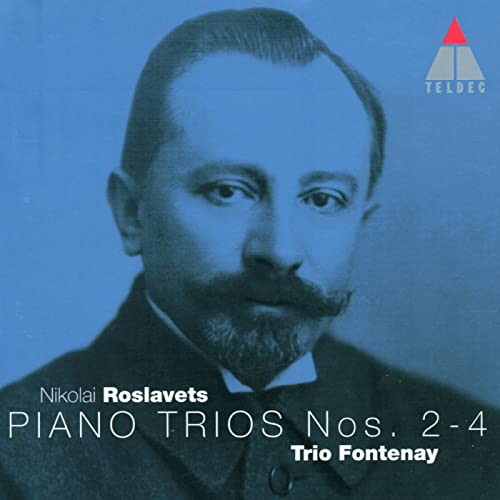
I was happy to find this album of Nicolai Roslavets' second, third and fourth piano trios by the German group Trio Fontenay. I've enjoyed the album, available on Hoopla Digital. I particularly liked the third trio.
I was curious why the trio had chosen those trios of Roslavets. Well, it turns out that they are the only ones that could be recorded -- the first and fifth piano trios are lost, according to the list of Roslavets' works on Wikipedia.
This sort of sad discovery is not unknown for the composers I am interested in. Alexander Mosolov wrote five piano sonatas, and I've listened to four of them again and again, but the third has been lost.
Monday, October 17, 2022
Some love for Gavriil Popov on Twitter

A photo of composer Gavriil Popov posted at the myaskoviev 2 Twitter account. The caption from the Tweet says, "Gavriil Popov (12 Sept 1904-1972) claims the dubious distinction of being the first Soviet composer to have a work banned outright after its premiere- the fate of Symphony no.1 (1935). Among composers named and shamed in 1948, his career never recovered and he died an alcoholic."
There are so many sources of information on the internet, I have to figure out what is worth my time and attention. A Twitter account I continue to make time for is the myaskofiev 2 account that I wrote about earlier, and which is the source of the Popov photo posted above.
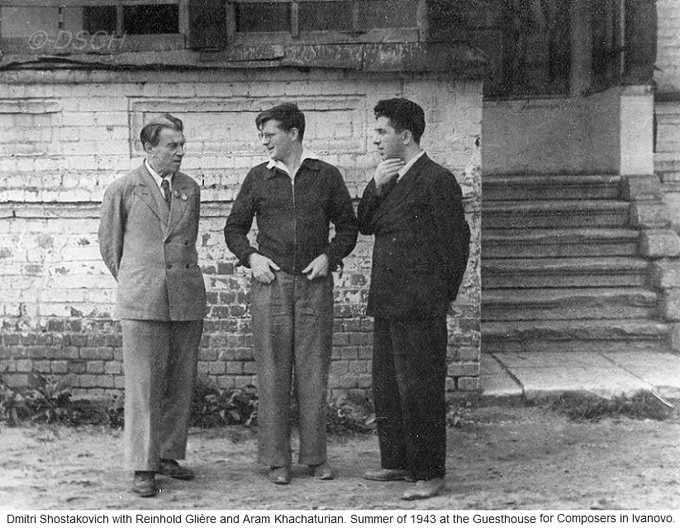
Here is another photo from the account I could not help bookmarking:
Speaking of Popov, I noticed that the Hoopla digital library app and website, available at most public libraries in the U.S., has added the Leon Botstein/London Symphony Orchestra performance of Popov's first symphony. It's a performance I haven't heard yet; I'll listen to it soon.
Sunday, October 9, 2022
New recording of Mosolov harp concerto

Alexander Mosolov's "lost" Concerto for Harp and Orchestra dates back to 1939, but it was not recorded until 2020, when a world premiere recording was made by conductor Arthur Arnold and the Moscow Symphony Orchestra, with harpist Taylor Ann Fleshman as the soloist.
Now there is a second recording. French harpist Xavier de Maistre has released a new recording of the Mosolov concerto, with WDR Sinfonieorchester Köln, conducted by Nathalie Stutzmann. The recording also has a Reinhold Glière harp concerto. More information here.
The album is available from the usual streaming services and at Freegal, the music streaming service offered by some public libraries in the U.S.
Monday, September 5, 2022
My favorite recording of Popov's first symphony
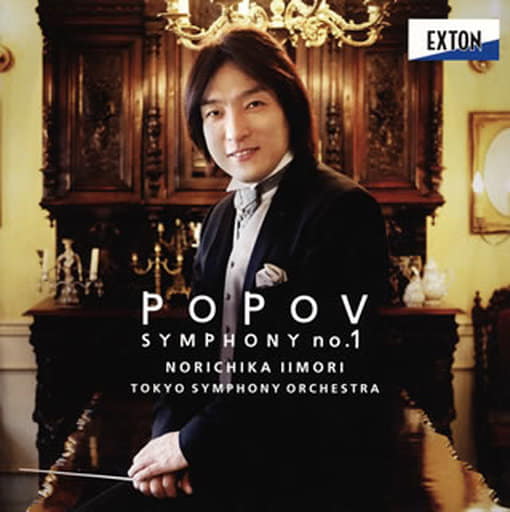
Gavriil Popov's Symphony No. 1 -- immediately banned after one performance in 1935 -- is one of his best works. It also apparently helped inspire my favorite Shostakovich symphony, the Fourth.
I've enjoyed all of the recordings of Popov's symphony that I've been able to find, but my favorite is conductor Norichika Iimori's recording with the Tokyo Symphony.
It's not easy to find a copy, but it's available from the Naxos Music Library, a classical music streaming service available from some libraries.
Update: I listened to this last night, and my opinion is confirmed. The first movement is amazingly noisy and violent, the second movement Largo is melodic and beautiful (until it gets the thunder going again.) I wish Popov could somehow hear this recording.
Monday, August 29, 2022
Vasily Petrenko is recording Myaskovsky

Vasily Petrenko, not to be confused with Kirill Petrenko (who is currently recovering from a broken toe) has taken on the praiseworthy task of trying to ensure that Nikolai Myaskovsky is not forgotten. Myaskovsky wrote 27 symphonies and apparently was considered a major composer in his day but doesn't get a lot of attention now.
Vasily Petrenko has recorded two albums with the Oslo Philharmonic which pair a Prokofiev symphony with a Myaskovsky symphony. A 2020 album has Prokofiev's fifth symphony with Myaskovsky's 21st. A 2021 recording has Prokofiev's sixth with Myaskovsky's 27th. Both albums are available on Freegal Music, the public library streaming service in the U.S.
This is not the Myaskovsky of his early days, when he was a leader of the Association for Contemporary Music, and a leader in the kind of "Russian Futurist" music this blog is concerned with, but I'm pleased to see Myaskovsky get some attention. I don't know whether the series will continue, but I'd like to hear what Petrenko does with Prokofiev's third symphony and whatever Myaskovsky he'd choose to pair it with.
Saturday, August 6, 2022
Steffen Schleiermacher's piano recitals

Steffen Schleiermacher (publicity photo from official website)
Steffen Schleiermacher, a German pianist, composer and conductor, has contributed to the revival of Russian Futurist music with three albums.
He has done two piano recitals albums of Russian Futurist piano music, Soviet Avant-Garde and Soviet Avant-Garde 2. The composers covered on these two recordings are Alexander Mosolov, Nikolai Roslavetz, Arthur Lourié, Sergei Protopopov and Leonid Polovinkin.

On those albums, he seemed to me to have a particular affinity for Mosolov, and in fact he is the featured pianist on a Mosolov collection with various artists issued by Capriccio which includes Mosolov's first piano concerto.
I should also point out that Herr Schleiermacher is a very prolific and hard working musician who has recorded a great deal of contemporary classical music by composers from all over the world, including the complete piano music of John Cage and the works of a very wide range of other composers, everyone from Morton Feldman to Stefan Wolpe, even avant-garde music from Indonesia! Explore his work at the official website. It has hard to think of another musician who has made a greater effort to connect listeners to modern classical music.
As far as I can tell, he isn't on social media, but he deserves to be better known.
Saturday, July 30, 2022
An interesting album
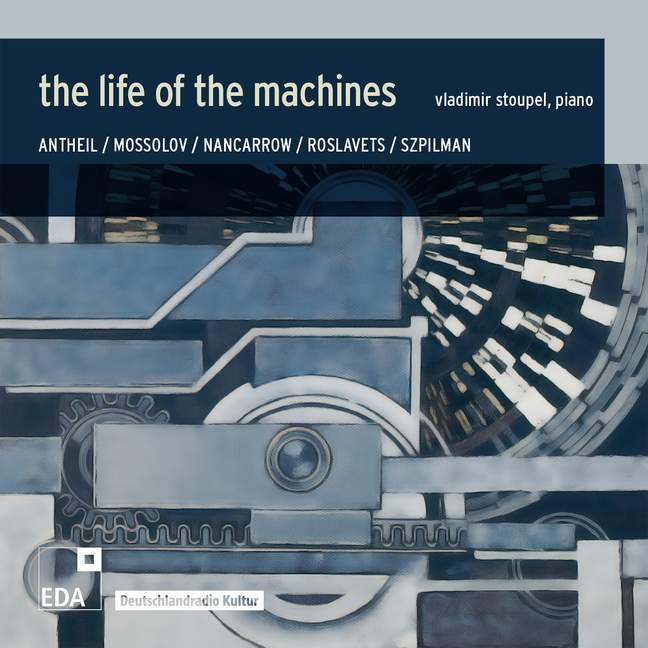
The Life of the Machines, a piano recital recorded by Russian born French pianist Vladimir Stoupel, is an interesting album I recently stumbled across on Freegal Music, the streaming music service offered by some public libraries in the U.S.
There are good performances of two substantial pieces by composers this blog is concerned about: The second piano sonata of Nikolai Roslavets, and the fourth piano sonata of Alexander Mosolov.
The other pieces -- by Conlon Nancarrow, Wladyslaw Szpilman and George Antheil -- put the two Russian pieces an an international context of Futurism. All are interesting; I particularly liked Antheil's fourth piano sonata, which convinces me I need to listen to Antheil more often.
Thursday, July 14, 2022
Sarah Rothenberg's historic album

Perhaps the first "Russian Futurist" piano album, Sarah Rothenberg's 1992 album Rediscovering the Russian Avant-Garde (1912-1925) remains important both as an excellent recording and as a pathbreaking work which led the way for many other recordings.
Rothenberg is a fine piano player, and her recordings of Mosolov's fourth and fifth piano sonatas persists as some of the best renditions of those two works. Whenever I listen to this album, I also particularly enjoy her performance of Nikolai Roslavetz' "Prelude." Alex Ross called it a "superb recital" in the New York Times back in 1994, and I have absolutely agree.
The review of the album at Allmusic, written by Uncle Dave Lewis, points out the importance of the recording in helping to revive interest in almost forgotten composers: "Featuring pianist Sarah Rothenberg, this collection practically introduced the subgenre of Russian futurist music to the market; even the first Russian recordings of composers such as Roslavets and Mosolov on Le Chant du Monde did not appear until a couple of years later."
The album is available at the Freegal public library music streaming service.
This album and an excellent Yuri Favorin recording covers a lot of the Russian piano music from early in the 20th century that you might want to know.
Saturday, July 9, 2022
Maybe Prokofiev and Shostakovich deserve a little sympathy

Alexander Mosolov, who continued composing even after being sent to a concentration camp.
The late Richard Taruskin has been getting dinged a bit for being hard on Prokofiev (for Prokofiev's supposed excessive deference to the Soviet regime.)
And in fact it's become kind of a cliche to beat up on Prokofiev and Shostakovich for not publicly standing up to Stalin, or whatever they were supposed to do to show their independence. Many of these criticisms come from folks who are safety inside the United States, or some other place where freedom of speech exists.
I can't help but point out that many American academics are discovering that it's easier to be brave in theory than in actual fact. Here is a comment posted recently on Bari Weiss' Substack on an article about the "Woke" atmosphere at American college campuses:
"I am one of the 99% who doesn't speak up publicly or professionally. I talk about it with friends and family, specifically the 'woke' ones, but I won't, for example, share an article like this on Facebook or speak up when a colleague casually mentions the prevalence of white supremacy in America. I work in an entirely different field but one only marginally less woke than higher education. I'm 34 and my career is just starting to have something resembling momentum. I think the ongoing revolution at American universities is the single most important threat to our country, including China, but I'm not going to be another white male easily dismissed for wrong think. I just can't do it." (Source). Others in the comments report similar situations.
Of course, being worried about being dismissed (if that's really a possibility, it's difficult to judge without more facts) is pretty serious.
Still, it's not the same thing as being tortured and shot, the fate of Vsevolod Meyerhold. (At the time, Meyerhold was working on Prokofiev's opera Semyon Kotko.) It's not the same as being shipped off to the Gulag, the fate of Alexander Mosolov. It's not the same as expecting to be arrested during the times of Stalinist repression, something Shostakovich had to endure. Prokofiev's wife was sent to a concentration camp. Of course, lots and lots of other examples can be cited, such as Shostakovich reading a Pravda editorial that threatened him.
Maybe it's not so easy being a target, particularly when you face a fate more serious than being criticized on Twitter. And maybe it's time to be a bit more sympathetic to Shostakovich and Prokofiev.
Friday, July 1, 2022
Richard Taruskin has died
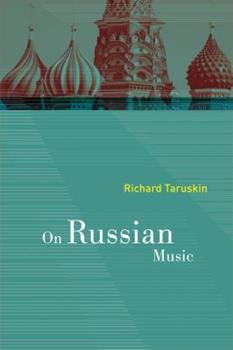
Prominent musicologist and author Richard Taruskin has died. The New York Times obituary (I take the Times, so I can get you behind the paywall) notes his prominence in writing about Russian music and discusses some of the controversies he took sides in:
"His words were anything but sterile: Mr. Taruskin courted controversy in nearly everything he wrote. In the late 1980s, he helped ignite the so-called 'Shostakovich Wars' by critiquing the veracity of Testimony: The Memoirs of Dmitri Shostakovich, as related to and edited by Solomon Volkov (1979), which portrayed the composer as a secret dissident. (Mr. Volkov is a journalist, historian and musicologist.) Drawing on a careful debunking by the scholar Laurel Fay, Mr. Taruskin called the book’s positive reception 'the greatest critical scandal I have ever witnessed'.”
Monday, June 27, 2022
Listening to Shebalin

Vissarion Shebalin
The 1948 Zhdanov condemnation of composers for "formalism" targeted many of my favorite composers, such as Shostakovich, Prokofiev and Popov, and so it seemed like a good idea to check out another of the condemned composers, Vissarion Shebalin.
This statement in the Wikipedia biography summarizes nicely what is often written about Shebalin: "Shebalin was one of the most cultured and erudite composers of his generation; his serious intellectual style and a certain academic approach to composition make him close to Myaskovsky."
The Freegal streaming music service offered at some public libraries has the first four of Shebalin's five symphonies, so I listened to them. I liked the first (1925) and the second (1929); the third (1935) and fourth (also 1935) made less of an impression on me.
When I tried researching Shebalin, I noticed he doesn't seem to get a lot of love. I could not find a website devoted to his music, and generally there just isn't much material out there.
Sunday, June 19, 2022
A must-follow Twitter account for Russian music fans

Caption for the above photo, taken from Twitter, "The infamous Tikhon Khrennikov (10 June 1913-2007) with the famous Sergei Prokofiev."
The photo is from the myaskoviev 2 Twitter account, which is run by a gentleman from Australia named Melvyn Madigan. The name of the account refers to Nicolai Myaskovsky and his pal Sergei Prokofiev. The current account is a successor to the myaskofiev Twitter account, where Mr. Madigan states his musical preferences: "TCHAIKOVSKY & PROKOFIEV are justly the most performed Russians. Also love Myaskovsky and others. (But, not Stravinsky, Shostakovich, Rachmaninov)."
This is half a loaf from my point of view, as I like Shostakovich and Stravinsky, but it's a very tasty half loaf, as I love Prokofiev and also enjoy Myaskovsky. But in fact, photos related to Shostakovich and Stravinsky do crop up. Below is another photo from the account I liked (I've copied Mr. Madigan's captions):

Prokofiev diary (Moscow), 16 April 1933: "Shostakovich, just back from Sverdlovsk, called in. He wanted me to take a score of his to Lenfilm. I told him about performances of his works in the West I had attended. We went to the Central Telegraph with his wife, charming woman."

The little guy is Vissarion Shebalin (11 June 1902-1963).
[And that's Prokofiev in the middle].
Monday, June 6, 2022
Marina Frolova-Walker on 1948 in Soviet music
1948 was a dramatic year in Soviet music; it saw the condemnation of Shostakovich, Prokofiev, Khachaturian, Myaskovsky, Popov, Shebalin and Popov. As Russian music specialist Marina Frolova-Walker notes in the interesting video lecture, above, the condemnation damaged all of the top composers at the time.
While some elements of the story did not surprise me, I learned many interesting or amusing details. For example, it's well-known that Shostakovich wrote the Song of the Forests to please Stalin, but I did not know that a tune from the work is a popular children's song in Japan. The remarks on what officials had to come up to award the Stalin Prize with so many top composers essentially ruled ineligible also was interesting. I have the video above, but for a transcript and other information, go here. Frolova-Walker is a Russian native but now a professor of music history at Cambridge University.
I would love to see a full list of the works condemned and banned from performance in 1948. I could not find it, the best I could do was this: "A signifcant part of denounced composers and their works are as follows: Shostakovich’s opera The Nose, Symphony Nos. 2, 3, 8, 9 and Second Piano Sonata; Prokofiev’s ballets The Prodigal Son, On the Boristhenes, Pas Dacier and his operas The Flaming Angel, War and Peace, Symphony Nos. 3, 4, 5, 6, Piano Concerto, Fifth Piano Sonata, and a number of piano works; Khachaturian’s Symphonie-Poeme; Mossolov’s Iron Foundry, Newspaper Advertisements; Knipper’s opera North Wind, Tales of a Porcelain Buddha; Shebalin’s Lenin Symphony, Symphony No. 2, the Quartet and String Trio; Popov’s Symphony No. 1; Liatoshinsky’s Symphony No. 2 and songs; Boelza’s Symphony Nos. 1, 2 and songs; Litinsky’s: Quartets and Sonatas; Shcherbachev’s Symphony No. 3, Popov’s Symphony No. 3, Miaskovsky’s Symphony Nos. 10, 13, Third Piano Sonata, Fourth Piano Sonata, etc." (Source).
The video lecture is part of a series although I can't find a handy playlist on YouTube, but this list of videos seems to do the job. There's much of interest at the official website for Professor Frolova-Walker, although the videos section needs to be updated.
Apparently her books are must-reads (she even wrote one on the Stalin Prize) and I will hunt them up soon.
Saturday, May 21, 2022
RIP Alexander Toradze
Soviet pianist Alexander Toradze (from Georgia) has died, and the New York Times has an obituary. (I can get you behind the firewall because I have a Times subscription -- subscribers can provide 10 links a month to social media, blogs, friends, etc.)
"In a 1984 review, Donal Henahan of The Times wrote of Mr. Toradze’s playing, 'It is the distinctive Russian style of an older generation, still alive in this era of stamped-out international virtuosos'.”
Here is Joe Horowitz' appreciation. And here is nice bonus entry from his blog.
Toradze apparently didn't make a lot of recordings, but I've been listening to his album (with the Kirov Orchestra and Valery Gergiev) of the Prokofiev piano concertos; it's worth a listen. It's on Hoopla Digital, which means that most Americans with a library card can listen to the album.
Hat tip: Eric Wagner.
I can't find a public domain/Creative Commons photo and apparently there are a lot of trolls out there who like to attack fair use, so sorry, no photo.
Subscribe to:
Posts (Atom)
-
 The Three Apostles of Russian Music: The Soviet Avant-Garde, Gregor Tassie, Lexington Books. I started this blog because I had discovered ...
 -
Gavriil Popov (1904-1972) is one of the major composers of what I call "Russian Futurism." And a relatively new string quarter,...
-
 Taylor Ann Fleshman (photo courtesy of the artist) I've been listening often to the important new Alexander Mosolov recording that in...
