A few days ago, I purchased the above album from Presto Music (a site that has a good selection of classical music, suitable for filling in some gaps in my collection) and I've listened to the recording several times. When I paid attention to the first piece in the suite, I thought, "Is that a theremin?"
So I ran a search, and here's the answer to my question, from Laurel Fay: "Appropriately, the performance features a theremin, an electronic instrument invented in Russia in the 1920s by Lev Termen (1896-1993). In his score, Popov offset the futuristic sound of the 'electric' theremin with the 'human' voices of a soprano and tenor." And here is another article.
The use of electronics alongside regular acoustic symphonic instruments is no longer startling; this Wikipedia piece on Finnish composer Kaija Saariaho notes, "Her work in the 1980s and 1990s was marked by an emphasis on timbre and the use of electronics alongside traditional instruments."
But Popov's piece dates to the early 1930s. Wouldn't the use of an electronic instrument in a "serious" composition back then be unusual and pioneering? Is there an earlier example?
The Three Apostles of Russian Music: The Soviet Avant-Garde, Gregor Tassie, Lexington Books.
I started this blog because I had discovered that I not only loved Prokofiev and Shostakovich, I also loved their lesser-known, very talented but persecuted colleagues, such as Nikolai Roslavets, Gavriil Popov and Alexander Mosolov. I was determined to do what I could to help others discover these composers.
Tassie previously authored a biography of Nikolai Myaskovsky and of two prominent Russian musicians, the conductors Yevgeny Mravinsky and Kirill Kondashin. The biography at the back of his new book states teasingly that he's now at work on a biography about "a celebrated Russian musician." He apparently speaks fluent Russian, allowing him to quiz Russian college professors who are experts on the trio he writes about and to dig through primary source archives.
The result is a book that is heavily researched and a wonderful resource for fans of Russian avant-garde classical music of the last century. Fans of Prokofiev and Shostakovich also will learn much by finding out more about the milieu of the two best-known Russian composers.
Tassie is careful to tell the reader which of the men's works are particularly good and deserve close attention; his judgment generally seems quite sound to me (i.e., I often found myself agreeing with him.) For example, when I recently listened to a recording by the German group Trio Fontenay of Roslavets' surviving piano trio works, I noticed that I particularly liked the third trio. Tassie refers to it as an "outstanding piece."
Indeed, readers will want to pay careful attention to sentences such as this one, about Roslavets' Chamber Symphony No. 2: "In the context of symphonic works written during the 1930s, Roslavets's symphony justifiably stands with Popov's First (1934), Shostakovich's Fourth (1936), and Myaskovsky's Tenth and Seventeenth (1930)."
Many of the composers Tassie writes about were particularly edgy early in their careers but adopted a more conservative approach in their later years, and Tassie is careful to note that these changes in direction weren't solely because of pressure from the Stalinist regime. Prokofiev, for example, was already moving toward a more approachable style before he returned to live in Russia. And Shostakovich, Tassie notes, showed signs of toning down his style even before the infamous attack in the pages of Pravda.
While Tassie obviously admires the composers he writes about, he also points out their failings. Popov is depicted as indolent, slow to finish his work and prone to missing deadlines. Mosolov was very careless about preserving his work. And in fact, it's sad how much music has been lost or is in jeopardy. Many of the works of the three composers have been sitting in archives for years and are only known through the efforts of dedicated Russian musicologists, who are named in Tassie's "Acknowledgements."
A careful reader will want to keep an eye not just on the text, but on the footnotes. For example, Tassie goes into considerable detail about Popov's film music, which allowed Popov to make a living when the composer got into trouble for "formalism," and at one point Tassie mentions a film director named Faintsimmer. The name meant nothing to me, but a note explains, "Alexander Mihailovich Faintsimmer (1906-1982) enjoyed a long career making his first movie in 1929 and notable for his 1934 film Lieutenant Kije with a score by Prokofiev, the suite from which became world famous."
As a kind of bonus, Tassie's final chapter discusses three more modernist Russian composers: Mikhail Matyushin, Arthur Lourié and Joseph Schillinger. The conclusion also puts Russian modernism in the context of global classical music modernism and touches on Russian composers who can be seen as successors to Tassie's trio.
The book includes a list of works for each composer and a list of recordings. Fortunately, as the trio continue to get more recordings, the list is already a bit out of date. The Popov Quartet Symphony, which Tassie apparently likes, finally got a recording.
This is a book aimed at the academic market and is unfortunately therefore rather expensive, so that perhaps some readers may have to resort to asking their local library to acquire it. That would also make the book available for others; good for Cleveland Public Library, where I found my copy, although (full disclosure) on the strength of this blog, the publisher agreed to let me have a review copy. I really wanted one; I am sure I will be referring to Tassie's excellent book many times.
Film poster for She Defends the Motherland. Gavriil Popov wrote the score for the movie and recycled much of the music into his second symphony.
Is this one of the saddest stories in classical music, or one of the weirdest?
Imagine that you are best known for a very long first symphony. Except that after one performance, it was banned, and you never got to hear it again. There have been at least four recordings of your symphony -- not bad for an obscure composer -- but you never got to hear them, because they weren't made until years after your death.
I knew the outlines of the story about Popov's symphony, but Tassie fills in details. The symphony was premiered in 1935 to a "mostly hostile audience" and Popov noted in his diary that the symphony was under rehearsed and poorly performed. That was the last performance and the last time Popov got to hear an orchestra playing it. The score resurfaced a decade after Popov's death, according to Tassie.
That wasn't Popov's only bad experience. Tassie reveals that Popov had hoped to write the score for Eisenstein's Alexander Nevsky movie. Of course, Prokofiev got the job instead. Popov tried to write an opera about Nevsky instead but ran into numerous obstacles and was never able to finish it.
Tassie's book also has depressing passages about the two other composers he focuses upon, Nicolai Roslavets and Alexander Mosolov. Shostakovich and Prokofiev managed to largely survive the system, but Tassie's trio had their troubles. But they also had their successes, and Tassie writes about that, too.
I did feel somewhat better about Popov's journey after I read the section about him on Tassie's book. The fate of his first symphony is sad, but despite the ban and the criticism he received for being a "formalist," he continued his composing career. He made a living largely by writing film scores, often recycling the film music into his symphonies and other compositions. I listened again last night to his second symphony, the "Motherland," and it's a very enjoyable potboiler. It was a comeback symphony, akin to Shostakovich's Fifth, and Popov had great success with it, which he understandably enjoyed.
I read dozens of books every year. Every once in awhile, I will run across a new book title and get the odd sensation that the author has written a book just for me.
While that doesn't happen often, it has just happened to me again.The Three Apostles of Russian Music by Gregor Tassie is not, as you might guess from the title, about Shostakovich, Prokofiev and Myaskovsky. It is in fact about three composers I focus upon at this blog: Nicolai Roslavets, Gavriil Popov and Alexander Mosolov.
I have only had time so far to read the Introduction and the first chapter of the library copy I managed to get my hands upon, but I can already report that the book is the product of immense research and that Tassie really knows his subject (he knows Russian fluently, he's in touch with all of the top Russian scholars of the three composers, he got help from staff at museums and institutes in Moscow and St. Petersburg, etc. etc.
This is the sort of book in which even the footnotes require careful study. Here is footnote No. 40, which points me to some Myaskovsky works to try: "Myaskovsky's Tenth, Eleventh, Thirteenth symphonies, and Fourth String Quartet did experiment with serialism -- author."
A photo of composer Gavriil Popov posted at the myaskoviev 2 Twitter account. The caption from the Tweet says, "Gavriil Popov (12 Sept 1904-1972) claims the dubious distinction of being the first Soviet composer to have a work banned outright after its premiere- the fate of Symphony no.1 (1935). Among composers named and shamed in 1948, his career never recovered and he died an alcoholic."
There are so many sources of information on the internet, I have to figure out what is worth my time and attention. A Twitter account I continue to make time for is the myaskofiev 2 account that I wrote about earlier, and which is the source of the Popov photo posted above.
Here is another photo from the account I could not help bookmarking:
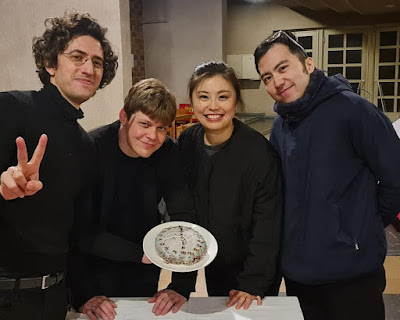
Quartet Berlin-Tokyo. From left, Dmitri Pavlov, Tsuyoshi Moriya, Ruiko Matsumoto and Gregor Hrabar.
When Quartet Berlin-Tokyo decided to do a world-premiere recording of Gavriil Popov's 57-minute "Quartet-Symphony," the 1951 String Quartet in C Major, Op. 61, the members didn't want to be rushed. So the quartet created its own record label, taking four weeks for the recording, as violist Gregor Hrabar explains in the interview below.
The new album, which also includes a shorter piece by Czech composer Erwin Schulhoff, "Five Pieces for String Quartet," has received rave reviews. And fans of Popov are happy to be able to hear nearly an hour of his music for the first time; many of his compositions apparently remain unrecorded. The CD can be purchased directly from the group and is available from many of the usual online outlets and streaming services.
Quartet Berlin-Tokyo features musicians from all over the world. Violinist Tsuyoshi Moriya and cellist Ruiko Matsumoto are from Japan. Violinist Dmitri Pavlov was born in Russia, but his family emigrated to Israel. Gregor Hrabar was born in Slovenia but also has studied music in Austria and Berlin. Learn more about the group at the official site at https://www.quartetberlintokyo.com/.
The new album is the first issued by the quartet's own record label, "QBT Collection," as Hrabar explained when I interviewed him by email:
Russian Futurism: Can you say something about how your quartet discovered the Gavriil Popov "Quartet Symphony," and why you decided to feature it on your first recording?
Gregor Hrabar: We were approached by a composer friend of ours, who also wrote a book about forgotten Soviet composers. In his opinion Popov was one of the greatest, if not the greatest of them all. So when we had a look at the score and gave it a shot, we immediately knew we wanted to record it. To record it with a label was impossible for us back in the day due to financial reasons, plus we didn't want to go through yet another recording session where you would maybe have 5 days under microphones, trying to reach the deadline and focusing on not making mistakes, instead of taking time and pushing the limits. Thus "QBT Collection" was born.
Russian Futurism: Can you tell me the name of your composer friend, and his or her book? I would love to read it, if it's available in English.
Gregor Hrabar: His name is Boris Yoffe. He is a good friend of the quartet and his "Quartettbuch" miniatures kept our spirits up during lockdown's restrictions of performing. 37 of them landed on YouTube as part of our "Micro-Concerts" series and more are still to come. His book is called "Im Fluss des Symphonischen", though I'm not sure if it has ever been translated to English. You can find the German copy under this link, at https://www.wolke-verlag.de/musikbuecher/boris-yoffe-im-fluss-des-symphonischen/.
Russian Futurism: You mentioned that having your own label allowed you to take your time with the recording, and do it right. How long did it take to record the album?
Gregor Hrabar: The recording process itself took us four weeks, and it took me a total of four months to edit it. We had a sort of a gentleman's agreement that the recording session will be an open-end production without stress of deadlines, only finishing when everyone is happy. Of course one cannot overstretch into a never-ending process, as there will be a certain time window of productivity. Still, we loved the idea of slow-cooking the pieces, as it became a very pleasant experience, even if incredibly intense. For myself in particular, as I took on the role of the sound engineer and producer, basically living with the score and the audio takes day and night.
Russian Futurism: Can you say anything yet about upcoming recording projects?
Gregor Hrabar: The plan is to have two recording sessions per season. One will be for an annual release, as the concept is to introduce a new album each year. The other will be for a bigger production, containing more works of a single composer, which will, of course, take more time to finish, especially now that concerts and tours are starting again. Recording of Vol.2 is scheduled for the second half of August. Apart from our own production, we are planning to record all the Op.33 of Joseph Haydn this year, by a kind invitation of EuroArts who will produce a DVD in Austria and Japan.
Gregor Hrabar
Russian Futurism: I have heard you might be recording more Russian music, can you comment on that yet?
Gregor Hrabar: It's currently too soon to confirm that I'm afraid. With Popov and Schulhoff being such absolute unanimous choices of the group and Popov being such a titan, it has been difficult to find a piece that could fill such big shoes. Also research into the unknown is tricky and it takes time, with outcomes being uncertain until the very end. But we do share very big love for the Slavic repertoire.
Russian Futurism: Is Quartet Berlin-Tokyo going to tour the U.S. anytime soon?
Gregor Hrabar: It is certainly a wish an a plan in motion, yes. The CD and Popov himself seem to have quite a big fandom in the States to our big surprise (Schulhoff too, which seems to be less known there), and we have shipped quite a few copies there already. The request of people being able to hear it live as well is growing and if it does turn out to happen, it will most likely be in 2024 or later.
Russian Futurism: Your band is truly international, as your name implies. How did you get together? Is English the "lingua franca" you use to talk to each other?
Gregor Hrabar: My colleagues met in 2011 as members of HfM "Hanns Eisler" and UDK in Berlin. I joined them in 2018. As languages go, it is a rather funny mixture of English, German and Japanese. Sometimes a bit of Slavic too, depending on how heated the conversation is 😛
Gavriil Popov (1904-1972) is one of the major composers of what I call "Russian Futurism." And a relatively new string quarter, Quartet Berlin-Tokyo, has performed a big service to classical music by releasing the world-premiere recording of Popov's "Quartet-Symphony," the 1951 String Quartet in C Major, Op . 61.
It's a long piece, about 57 minutes long. The album pairs it with a short piece by the interesting Czech composer Erwin Schulhoff, "Five Pieces for String Quartet." The album is getting excellent reviews, such as this one ("the rediscovery of the Popow Quartet is a very strong argument for this album.")
Popov is chiefly remembered for two early pieces, his 1935 First Symphony (banned after one performance) and, from 1927, his chamber symphony. Recordings of those two are not difficult to find, but the Quartet Berlin-Tokyo release is the only way to listen to the Quartet Symphony, which dates from 1951.