Monday, October 17, 2022

Some love for Gavriil Popov on Twitter


A photo of composer Gavriil Popov posted at the myaskoviev 2 Twitter account. The caption from the Tweet says, "Gavriil Popov (12 Sept 1904-1972) claims the dubious distinction of being the first Soviet composer to have a work banned outright after its premiere- the fate of Symphony no.1 (1935). Among composers named and shamed in 1948, his career never recovered and he died an alcoholic."

There are so many sources of information on the internet, I have to figure out what is worth my time and attention. A Twitter account I continue to make time for is the myaskofiev 2 account that I wrote about earlier, and which is the source of the Popov photo posted above. 

Here is another photo from the account I could not help bookmarking: 
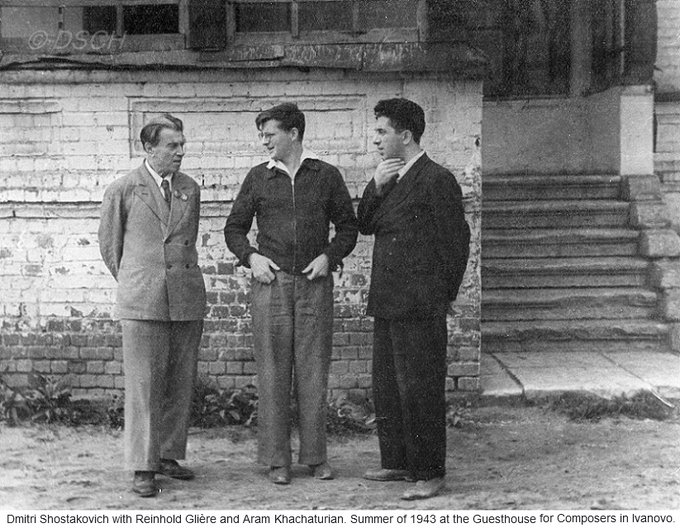

Speaking of Popov, I noticed that the Hoopla digital library app and website, available at most public libraries in the U.S., has added the Leon Botstein/London Symphony Orchestra performance of Popov's first symphony. It's a performance I haven't heard yet; I'll listen to it soon. 


Sunday, October 9, 2022

New recording of Mosolov harp concerto


Alexander Mosolov's "lost" Concerto for Harp and Orchestra dates back to 1939, but it was not recorded until 2020, when a world premiere recording was made by conductor Arthur Arnold and the Moscow Symphony Orchestra, with harpist Taylor Ann Fleshman as the soloist.

Now there is a second recording.  French harpist Xavier de Maistre has released a new recording of the Mosolov concerto, with WDR Sinfonieorchester Köln, conducted by Nathalie Stutzmann. The recording also has a Reinhold Glière harp concerto. More information here. 

The album is available from the usual streaming services and at Freegal, the music streaming service offered by some public libraries in the U.S. 


Monday, September 5, 2022

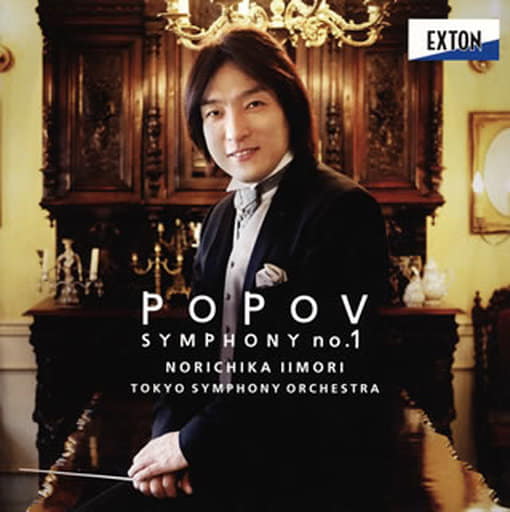
My favorite recording of Popov's first symphony


Gavriil Popov's Symphony No. 1 -- immediately banned after one performance in 1935 -- is one of his best works. It also apparently helped inspire my favorite Shostakovich symphony, the Fourth.

I've enjoyed all of the recordings of Popov's symphony that I've been able to find, but my favorite is conductor Norichika Iimori's recording with the Tokyo Symphony. 

It's not easy to find a copy, but it's available from the Naxos Music Library, a classical music streaming service available from some libraries. 

Update: I listened to this last night, and my opinion is confirmed. The first movement is amazingly noisy and violent, the second movement Largo is melodic and beautiful (until it gets the thunder going again.) I wish Popov could somehow hear this recording. 


Monday, August 29, 2022

Vasily Petrenko is recording Myaskovsky


Vasily Petrenko, not to be confused with Kirill Petrenko (who is currently recovering from a broken toe)  has taken on the praiseworthy task of trying to ensure that Nikolai Myaskovsky is not forgotten. Myaskovsky wrote 27 symphonies and apparently was considered a major composer in his day but doesn't get a lot of attention now.

Vasily Petrenko has recorded two albums with the Oslo Philharmonic which pair a Prokofiev symphony with a Myaskovsky symphony. A 2020 album has Prokofiev's fifth symphony with Myaskovsky's 21st. A 2021 recording has Prokofiev's sixth with Myaskovsky's 27th. Both albums are available on Freegal Music, the public library streaming service in the U.S. 

This is not the Myaskovsky of his early days, when he was a leader of the Association for Contemporary Music, and a leader in the kind of "Russian Futurist" music this blog is concerned with, but I'm pleased to see Myaskovsky get some attention. I don't know whether the series will continue, but I'd like to hear what Petrenko does with Prokofiev's third symphony and whatever Myaskovsky he'd choose to pair it with.


Saturday, August 6, 2022

Steffen Schleiermacher's piano recitals


Steffen Schleiermacher (publicity photo from official website)

Steffen Schleiermacher, a German pianist, composer and conductor, has contributed to the revival of Russian Futurist music with three albums. 

He has done two piano recitals albums of Russian Futurist piano music, Soviet Avant-Garde and Soviet Avant-Garde 2.   The composers covered on these two recordings are Alexander Mosolov, Nikolai Roslavetz,  Arthur Lourié, Sergei Protopopov and Leonid Polovinkin. 


On those albums, he seemed to me to have a particular affinity for Mosolov, and in fact he is the featured pianist on a Mosolov collection with various artists issued by Capriccio which includes Mosolov's first piano concerto. 

I should also point out that Herr Schleiermacher is a very prolific and hard working musician who has recorded a great deal of contemporary classical music by composers from all over the world, including the complete piano music of John Cage and the works of a very wide range of other composers, everyone from Morton Feldman to Stefan Wolpe, even avant-garde music from Indonesia! Explore his work at the official website.  It has hard to think of another musician who has made a greater effort to connect listeners to modern classical music. 

As far as I can tell, he isn't on social media, but he deserves to be better known. 


Saturday, July 30, 2022

An interesting album


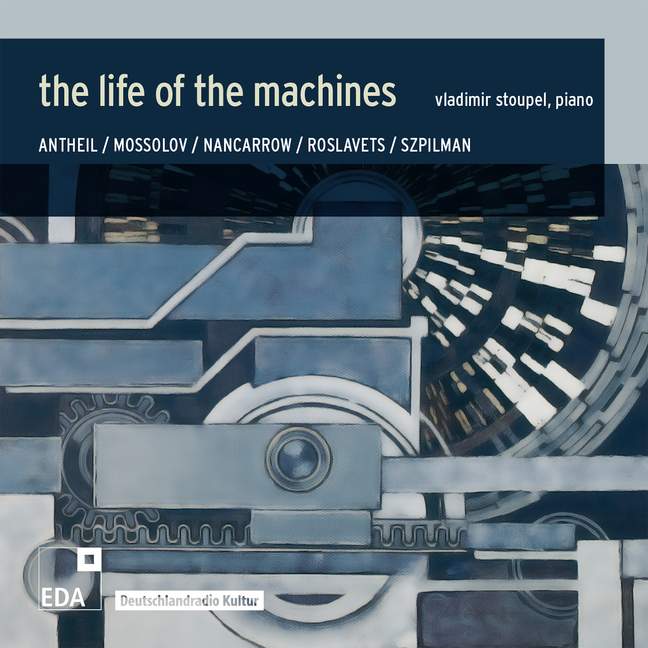
The Life of the Machines, a piano recital recorded by Russian born French pianist Vladimir Stoupel, is an interesting album I recently stumbled across on Freegal Music, the streaming music service offered by some public libraries in the U.S. 

There are good performances of two substantial pieces by composers this blog is concerned about: The second piano sonata of Nikolai Roslavets, and the fourth piano sonata of Alexander Mosolov. 

The other pieces -- by Conlon Nancarrow, Wladyslaw Szpilman and George Antheil -- put the two Russian pieces an an international context of Futurism. All are interesting; I particularly liked Antheil's fourth piano sonata, which convinces me I need to listen to Antheil more often. 


Thursday, July 14, 2022

Sarah Rothenberg's historic album


Perhaps the first "Russian Futurist" piano album, Sarah Rothenberg's 1992 album Rediscovering the Russian Avant-Garde (1912-1925) remains important both as an excellent recording and as a pathbreaking work which led the way for many other recordings.

Rothenberg is a fine piano player, and her recordings of Mosolov's fourth and fifth piano sonatas persists as some of the best renditions of those two works. Whenever I listen to this album, I also particularly enjoy her performance of Nikolai Roslavetz' "Prelude." Alex Ross called it a "superb recital" in the New York Times back in 1994, and I have absolutely agree. 

The review of the album at Allmusic, written by Uncle Dave Lewis, points out the importance of the recording in helping to revive interest in almost forgotten composers: "Featuring pianist Sarah Rothenberg, this collection practically introduced the subgenre of Russian futurist music to the market; even the first Russian recordings of composers such as Roslavets and Mosolov on Le Chant du Monde did not appear until a couple of years later."

The album is available at the Freegal public library music streaming service. 

This album and an excellent Yuri Favorin recording covers a lot of the Russian piano music from early in the 20th century that you might want to know. 


I've gone Substack

I'm going to try publishing this blog on Substack; please go here to see new posts and an archive of all of my older posts. I'll h...