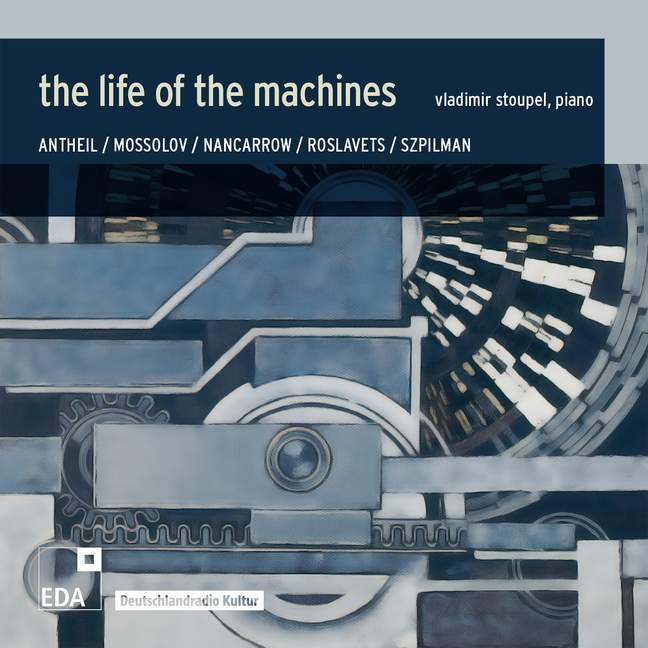
The Life of the Machines, a piano recital recorded by Russian born French pianist Vladimir Stoupel, is an interesting album I recently stumbled across on Freegal Music, the streaming music service offered by some public libraries in the U.S.
There are good performances of two substantial pieces by composers this blog is concerned about: The second piano sonata of Nikolai Roslavets, and the fourth piano sonata of Alexander Mosolov.
The other pieces -- by Conlon Nancarrow, Wladyslaw Szpilman and George Antheil -- put the two Russian pieces an an international context of Futurism. All are interesting; I particularly liked Antheil's fourth piano sonata, which convinces me I need to listen to Antheil more often.
Perhaps the first "Russian Futurist" piano album, Sarah Rothenberg's 1992 album Rediscovering the Russian Avant-Garde (1912-1925) remains important both as an excellent recording and as a pathbreaking work which led the way for many other recordings.
Rothenberg is a fine piano player, and her recordings of Mosolov's fourth and fifth piano sonatas persists as some of the best renditions of those two works. Whenever I listen to this album, I also particularly enjoy her performance of Nikolai Roslavetz' "Prelude." Alex Ross called it a "superb recital" in the New York Times back in 1994, and I have absolutely agree.
The review of the album at Allmusic, written by Uncle Dave Lewis, points out the importance of the recording in helping to revive interest in almost forgotten composers: "Featuring pianist Sarah Rothenberg, this collection practically introduced the subgenre of Russian futurist music to the market; even the first Russian recordings of composers such as Roslavets and Mosolov on Le Chant du Monde did not appear until a couple of years later."
Alexander Mosolov, who continued composing even after being sent to a concentration camp.
The late Richard Taruskin has been getting dinged a bit for being hard on Prokofiev (for Prokofiev's supposed excessive deference to the Soviet regime.)
And in fact it's become kind of a cliche to beat up on Prokofiev and Shostakovich for not publicly standing up to Stalin, or whatever they were supposed to do to show their independence. Many of these criticisms come from folks who are safety inside the United States, or some other place where freedom of speech exists.
I can't help but point out that many American academics are discovering that it's easier to be brave in theory than in actual fact. Here is a comment posted recently on Bari Weiss' Substack on an article about the "Woke" atmosphere at American college campuses:
"I am one of the 99% who doesn't speak up publicly or professionally. I talk about it with friends and family, specifically the 'woke' ones, but I won't, for example, share an article like this on Facebook or speak up when a colleague casually mentions the prevalence of white supremacy in America. I work in an entirely different field but one only marginally less woke than higher education. I'm 34 and my career is just starting to have something resembling momentum. I think the ongoing revolution at American universities is the single most important threat to our country, including China, but I'm not going to be another white male easily dismissed for wrong think. I just can't do it." (Source). Others in the comments report similar situations.
Of course, being worried about being dismissed (if that's really a possibility, it's difficult to judge without more facts) is pretty serious.
Still, it's not the same thing as being tortured and shot, the fate of Vsevolod Meyerhold. (At the time, Meyerhold was working on Prokofiev's opera Semyon Kotko.) It's not the same as being shipped off to the Gulag, the fate of Alexander Mosolov. It's not the same as expecting to be arrested during the times of Stalinist repression, something Shostakovich had to endure. Prokofiev's wife was sent to a concentration camp. Of course, lots and lots of other examples can be cited, such as Shostakovich reading a Pravda editorial that threatened him.
Maybe it's not so easy being a target, particularly when you face a fate more serious than being criticized on Twitter. And maybe it's time to be a bit more sympathetic to Shostakovich and Prokofiev.
Prominent musicologist and author Richard Taruskin has died. The New York Times obituary (I take the Times, so I can get you behind the paywall) notes his prominence in writing about Russian music and discusses some of the controversies he took sides in:
"His words were anything but sterile: Mr. Taruskin courted controversy in nearly everything he wrote. In the late 1980s, he helped ignite the so-called 'Shostakovich Wars' by critiquing the veracity of Testimony: The Memoirs of Dmitri Shostakovich, as related to and edited by Solomon Volkov (1979), which portrayed the composer as a secret dissident. (Mr. Volkov is a journalist, historian and musicologist.) Drawing on a careful debunking by the scholar Laurel Fay, Mr. Taruskin called the book’s positive reception 'the greatest critical scandal I have ever witnessed'.”
The 1948 Zhdanov condemnation of composers for "formalism" targeted many of my favorite composers, such as Shostakovich, Prokofiev and Popov, and so it seemed like a good idea to check out another of the condemned composers, Vissarion Shebalin.
This statement in the Wikipedia biography summarizes nicely what is often written about Shebalin: "Shebalin was one of the most cultured and erudite composers of his generation; his serious intellectual style and a certain academic approach to composition make him close to Myaskovsky."
The Freegal streaming music service offered at some public libraries has the first four of Shebalin's five symphonies, so I listened to them. I liked the first (1925) and the second (1929); the third (1935) and fourth (also 1935) made less of an impression on me.
When I tried researching Shebalin, I noticed he doesn't seem to get a lot of love. I could not find a website devoted to his music, and generally there just isn't much material out there.
Caption for the above photo, taken from Twitter, "The infamous Tikhon Khrennikov (10 June 1913-2007) with the famous Sergei Prokofiev."
The photo is from the myaskoviev 2 Twitter account, which is run by a gentleman from Australia named Melvyn Madigan. The name of the account refers to Nicolai Myaskovsky and his pal Sergei Prokofiev. The current account is a successor to the myaskofiev Twitter account, where Mr. Madigan states his musical preferences: "TCHAIKOVSKY & PROKOFIEV are justly the most performed Russians. Also love Myaskovsky and others. (But, not Stravinsky, Shostakovich, Rachmaninov)."
This is half a loaf from my point of view, as I like Shostakovich and Stravinsky, but it's a very tasty half loaf, as I love Prokofiev and also enjoy Myaskovsky. But in fact, photos related to Shostakovich and Stravinsky do crop up. Below is another photo from the account I liked (I've copied Mr. Madigan's captions):
Prokofiev diary (Moscow), 16 April 1933: "Shostakovich, just back from Sverdlovsk, called in. He wanted me to take a score of his to Lenfilm. I told him about performances of his works in the West I had attended. We went to the Central Telegraph with his wife, charming woman."
The little guy is Vissarion Shebalin (11 June 1902-1963).
1948 was a dramatic year in Soviet music; it saw the condemnation of Shostakovich, Prokofiev, Khachaturian, Myaskovsky, Popov, Shebalin and Popov. As Russian music specialist Marina Frolova-Walker notes in the interesting video lecture, above, the condemnation damaged all of the top composers at the time.
While some elements of the story did not surprise me, I learned many interesting or amusing details. For example, it's well-known that Shostakovich wrote the Song of the Forests to please Stalin, but I did not know that a tune from the work is a popular children's song in Japan. The remarks on what officials had to come up to award the Stalin Prize with so many top composers essentially ruled ineligible also was interesting. I have the video above, but for a transcript and other information, go here. Frolova-Walker is a Russian native but now a professor of music history at Cambridge University.
I would love to see a full list of the works condemned and banned from performance in 1948. I could not find it, the best I could do was this: "A signifcant part of denounced composers and their works are as follows: Shostakovich’s opera The Nose, Symphony Nos. 2, 3, 8, 9 and Second Piano Sonata; Prokofiev’s ballets The Prodigal Son, On the Boristhenes, Pas Dacier and his operas The Flaming Angel, War and Peace, Symphony Nos. 3, 4, 5, 6, Piano Concerto, Fifth Piano Sonata, and a number of piano works; Khachaturian’s Symphonie-Poeme; Mossolov’s Iron Foundry, Newspaper Advertisements; Knipper’s opera North Wind, Tales of a Porcelain Buddha; Shebalin’s Lenin Symphony, Symphony No. 2, the Quartet and String Trio; Popov’s Symphony No. 1; Liatoshinsky’s Symphony No. 2 and songs; Boelza’s Symphony Nos. 1, 2 and songs; Litinsky’s: Quartets and Sonatas; Shcherbachev’s Symphony No. 3, Popov’s Symphony No. 3, Miaskovsky’s Symphony Nos. 10, 13, Third Piano Sonata, Fourth Piano Sonata, etc." (Source).