Friday, November 11, 2022

Exciting new book on Russian avant-garde composers


I read dozens of books every year. Every once in awhile, I will run across a new book title and get the odd sensation that the author has written a book just for me.

While that doesn't happen often, it has just happened to me again. The Three Apostles of Russian Music by Gregor Tassie is not, as you might guess from the title, about Shostakovich, Prokofiev and Myaskovsky. It is in fact about three composers I focus upon at this blog: Nicolai Roslavets, Gavriil Popov and Alexander Mosolov.

I have only had time so far to read the Introduction and the first chapter of the library copy I managed to get my hands upon, but I can already report that the book is the product of immense research and that Tassie really knows his subject (he knows Russian fluently, he's in touch with all of the top Russian scholars of the three composers, he got help from staff at museums and institutes in Moscow and St. Petersburg, etc. etc. 

This is the sort of book in which even the footnotes require careful study. Here is footnote No. 40, which points me to some Myaskovsky works to try: "Myaskovsky's Tenth, Eleventh, Thirteenth symphonies, and Fourth String Quartet did experiment with serialism -- author." 


Friday, November 4, 2022

Larry Sitsky's Russian Futurism book and music recordings


Larry Sitsky is a prominent Australian composer; the guy who does the myaskofiev 2 Twitter account, Melvyn Madigan, tells me Sitsky is well known as a composer in Australia, although perhaps most respected as an academic, writer and pianist. He's also Australia's most commissioned composer, Madigan tells me. 

Sitsky has tried to promote the music I write about  here in two different ways.

His book, Music of the Repressed Russian Avant-Garde, 1900-1929, covers the music I write about in this blog. It is written for musicologists, but I was able to understand parts of it, such as Sitsky's contention that Alexander Mosolov's piano sonatas are just as good as Prokofiev's. It's a pretty expensive book, unfortunately, and I can't afford it. 

Sitsky also has recorded an album, Russian Rarities, which has almost four hours of piano music. The composers featured on the album are Vladimir Deshevov, Arthur Lourie, Alexander Mosolov, Nicolai Obukhov, Leonid Polovinkin, Vladimir Rebikov, Nikolai Roslavets, Anton Rubinstein and Vladimir Scherbakov. 

Sitsky's notes on the album are available online. He writes, "Were it not for the eventual Stalinist suppression, the group of composers represented on these CDs could well have led and surpassed their European counterparts in their sheer audacity and exuberance." If you stream the album, you can download the digital booklet. 


Saturday, October 29, 2022

A Roslavets album that makes me both happy and sad


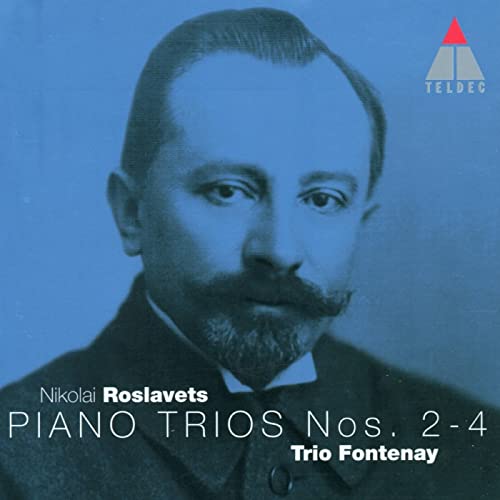
I was happy to find this album of Nicolai Roslavets' second, third and fourth piano trios by the German group Trio Fontenay.  I've enjoyed the album, available on Hoopla Digital. I particularly liked the third trio. 

I was curious why the trio had chosen those trios of Roslavets. Well, it turns out that they are the only ones that could be recorded -- the first and fifth piano trios are lost, according to the list of Roslavets' works on Wikipedia. 

This sort of sad discovery is not unknown for the composers I am interested in. Alexander Mosolov wrote five piano sonatas, and I've listened to four of them again and again, but the third has been lost. 

Monday, October 17, 2022

Some love for Gavriil Popov on Twitter


A photo of composer Gavriil Popov posted at the myaskoviev 2 Twitter account. The caption from the Tweet says, "Gavriil Popov (12 Sept 1904-1972) claims the dubious distinction of being the first Soviet composer to have a work banned outright after its premiere- the fate of Symphony no.1 (1935). Among composers named and shamed in 1948, his career never recovered and he died an alcoholic."

There are so many sources of information on the internet, I have to figure out what is worth my time and attention. A Twitter account I continue to make time for is the myaskofiev 2 account that I wrote about earlier, and which is the source of the Popov photo posted above. 

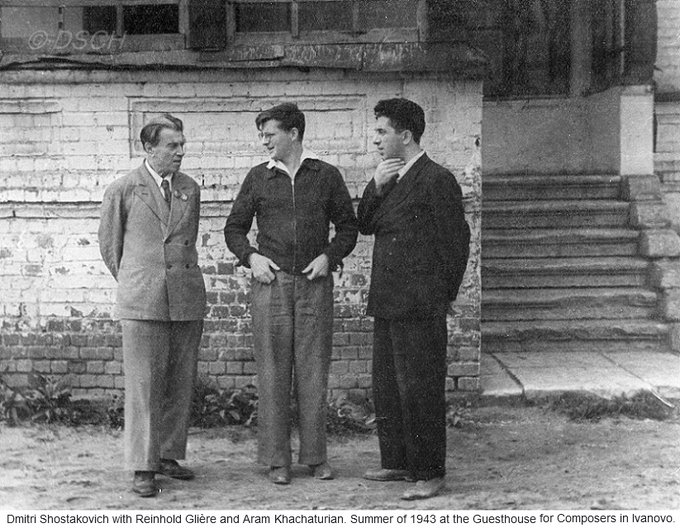
Here is another photo from the account I could not help bookmarking: 


Speaking of Popov, I noticed that the Hoopla digital library app and website, available at most public libraries in the U.S., has added the Leon Botstein/London Symphony Orchestra performance of Popov's first symphony. It's a performance I haven't heard yet; I'll listen to it soon. 


Sunday, October 9, 2022

New recording of Mosolov harp concerto


Alexander Mosolov's "lost" Concerto for Harp and Orchestra dates back to 1939, but it was not recorded until 2020, when a world premiere recording was made by conductor Arthur Arnold and the Moscow Symphony Orchestra, with harpist Taylor Ann Fleshman as the soloist.

Now there is a second recording.  French harpist Xavier de Maistre has released a new recording of the Mosolov concerto, with WDR Sinfonieorchester Köln, conducted by Nathalie Stutzmann. The recording also has a Reinhold Glière harp concerto. More information here. 

The album is available from the usual streaming services and at Freegal, the music streaming service offered by some public libraries in the U.S. 


Monday, September 5, 2022

My favorite recording of Popov's first symphony


Gavriil Popov's Symphony No. 1 -- immediately banned after one performance in 1935 -- is one of his best works. It also apparently helped inspire my favorite Shostakovich symphony, the Fourth.

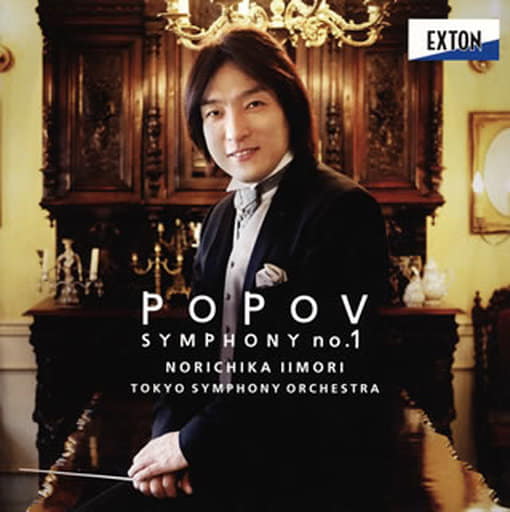
I've enjoyed all of the recordings of Popov's symphony that I've been able to find, but my favorite is conductor Norichika Iimori's recording with the Tokyo Symphony. 

It's not easy to find a copy, but it's available from the Naxos Music Library, a classical music streaming service available from some libraries. 

Update: I listened to this last night, and my opinion is confirmed. The first movement is amazingly noisy and violent, the second movement Largo is melodic and beautiful (until it gets the thunder going again.) I wish Popov could somehow hear this recording. 


Monday, August 29, 2022

Vasily Petrenko is recording Myaskovsky


Vasily Petrenko, not to be confused with Kirill Petrenko (who is currently recovering from a broken toe)  has taken on the praiseworthy task of trying to ensure that Nikolai Myaskovsky is not forgotten. Myaskovsky wrote 27 symphonies and apparently was considered a major composer in his day but doesn't get a lot of attention now.

Vasily Petrenko has recorded two albums with the Oslo Philharmonic which pair a Prokofiev symphony with a Myaskovsky symphony. A 2020 album has Prokofiev's fifth symphony with Myaskovsky's 21st. A 2021 recording has Prokofiev's sixth with Myaskovsky's 27th. Both albums are available on Freegal Music, the public library streaming service in the U.S. 

This is not the Myaskovsky of his early days, when he was a leader of the Association for Contemporary Music, and a leader in the kind of "Russian Futurist" music this blog is concerned with, but I'm pleased to see Myaskovsky get some attention. I don't know whether the series will continue, but I'd like to hear what Petrenko does with Prokofiev's third symphony and whatever Myaskovsky he'd choose to pair it with.


I've gone Substack

I'm going to try publishing this blog on Substack; please go here to see new posts and an archive of all of my older posts. I'll h...