Sunday, March 20, 2022

World premiere for Gavriil Popov piece


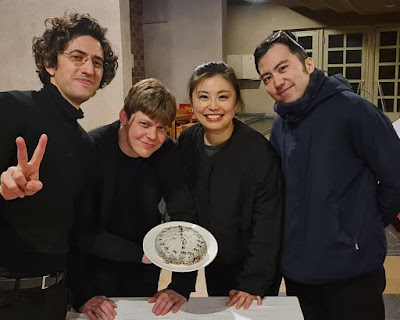
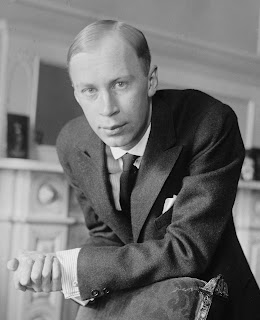
Gavriil Popov (1904-1972) is one of the major composers of what I call "Russian Futurism." And a relatively new string quarter, Quartet Berlin-Tokyo, has performed a big service to classical music by releasing the world-premiere recording of Popov's "Quartet-Symphony," the 1951 String Quartet in C Major, Op . 61. 

It's a long piece, about 57 minutes long. The album pairs it with a short  piece by the interesting Czech composer Erwin Schulhoff, "Five Pieces for String Quartet." The album is getting excellent reviews, such as this one ("the rediscovery of the Popow Quartet is a very strong argument for this album.")

Popov is chiefly remembered for two early pieces, his 1935 First Symphony (banned after one performance) and, from 1927,  his chamber symphony. Recordings of those two are not difficult to find, but the Quartet Berlin-Tokyo release is the only way to listen to the Quartet Symphony, which dates from 1951. 

If you become interested in Popov, you may want to know that a Popov piano piece is included in this excellent album by Yury Favorin. 


Quartet Berlin-Tokyo


Wednesday, March 9, 2022

Sad news from Moscow: Arthur Arnold resigns


Arthur Arnold (Facebook photo)

Arthur Arnold has resigned as the music director of the Moscow Symphony Orchestra. It's the orchestra that recorded an album of previously unavailable Alexander Mosolov music; I did several posts about it, including this piece. 

Here is Mr. Arnold's posting on Facebook announcing his decision:

"It is with the greatest conviction and with an immense sadness that I resign from my position as music director of the Moscow Symphony Orchestra (MSO) in Russia, effective immediately.

"The MSO is not state-supported and has never been since its inception in 1989. Nonetheless, I feel that I cannot collaborate with a country whose president chooses war as a solution to conflict and causes incredible human tragedy.

"The fruitful artistic cooperation, which started with a concert in the Amsterdam Concertgebouw in 2004, will be sorely missed.

"My heart goes out to the people in Ukraine and everyone suffering from this needless war. I am proud to join with the countless people across the world who are raising their voices and taking a stand."

Judging from the comments, most agree with Arnold but a few believe it was the wrong decision, as the orchestra is independent of the Russian state (as Arnold himself says). 

Here is the post, with comments. 

The patron behind the Mosolov album and what were supposed to be other efforts to bring Russian music to life, e.g. the "Mosolov project," is Max Gutbrod. He commented,

"Reminds me of the discussion of Furtwänglers role in Nazi time. My impression was that the real issue with him was that he decorated events for the regime and later on did as if he were not involved. In contrast, already when we did https://www.youtube.com/watch?v=Mza8p_iM2gE... together it was rather non-official, a type of opposition type. More broadly, I would think music can help to oppose, and there are great examples of the same, not least Mrs. Kalesnikava. Be it as it may, I am looking forward to exploring options to further the Mosolov-project with Arthur Arnold."

I hope he can find workable options. 

Thursday, March 3, 2022

Can Daniil Trifonov help Mosolov become better known?

Daniil Trifonov playing at Carnegie Hall in 2017 (Creative Commons photo). 

I have been listening to the extended version of The Silver Age by the pianist Daniil Trifonov. I learned about the album via Tyler Cowen, who noted that it has been one of the best reviewed albums of 2021.  It's available on Hoopla Digital, which is offered by most public libraries in the U.S. 

While the new album has music by Stravinsky, Prokofiev and Scriabin, there is the intriguing possibility that Trifonov might consider recording music by Alexander Mosolov. An article from the Chicago Symphony Orchestra's website says:

"Trifonov is also learning a concerto by little-known Russian composer Alexander Mosolov (1900-1973), who served in World War I and received a medical discharge because of post-traumatic stress disorder. He graduated from the Moscow Conservatory in 1925, but ran afoul of Soviet authorities in the 1930s, getting a prison sentence shortened only through the intervention of some prominent fellow composers. Trifonov calls the composer’s virtually unknown concerto a 'bit of a curiosity': 'It’s quite an original work, and it’s almost never played.' ”

While it's certainly already possible to listen to recordings of Mosolov's first piano concerto -- I own two of them, one featuring pianist Rusudan Khuntsaria, the other with Steffen Schleiermacher as the soloist -- a recording by someone as well known as Trifonov would be helpful in providing attention to Mosolov. 


Tuesday, March 1, 2022

I still like Russian music


Sergei Prokofiev, born in what is now the eastern Ukraine. 

I have switched from working full time to working part time -- I am kind of semi-retired -- and so I have more time to work on this blog and revive it. My timing for this effort appears to be a bit awkward. 

While I am interested in classical music generally, the focus of this blog has been on Russian classical music of the 20th century, particularly the avant garde movement of the 1920s and 1930s -- not just Prokofiev and Shostakovich, who obviously don't need any help from me, but also particularly neglected figures such as Alexander Mosolov and Gavriil Popov. 

What all of these composers, and many more I can name, have in common is that they all in various ways managed to get into trouble with the Soviet regime. I am horrified by the ongoing invasion of Ukraine and I've never been a Putin fan, but there seems to be a general dumb abhorrence of all things Russian. I still think the music I am promoting is beautiful and deserves to be known.

Possibly related: Tyler Cowen on "Anti-Russian sentiment is the new McCarthyism." 

I disagree with most of the comments for Tyler's post, but agree with the one posted by Tom Meadowcroft: "Once again the MR comment section makes it clear that liberalism is an intellectual idea which is quickly abandoned as soon as something emotionally triggering happens. Tyler is entirely correct; we shouldn't punish all Russians for the sins of Putin, nor even those who have supported him in the past. It is fair game to punish those who support this war against Ukraine in words or deeds, but punishment for a mere association with Putin and his government is deeply illiberal. But it's the sort of thing that people who have no other means to object to the war can do to signal virtue and make themselves feel good about themselves.

"Liberalism is quickly abandoned when confronted with blood or money. It is not emotionally satisfying. That is why preserving liberal norms will always be a struggle."

Also: Moscow Times is one of the few remaining independent newspapers in Russia. It likely deserves your attention and support. 


Monday, August 16, 2021

RIP Boom


Professor Vadim Batitsky, the "Boom" who wrote the Boom's Dungeon blog. 

Of course Carter's audience is still relatively small.  But then the audience for art music in general is minuscule compared to the millions who crave endlessly recycled vapid clichés of pop music.  Which only proves that those who (like Richard Taruskin) evaluate a composer's style in terms of the size of his audience simply confuse art music with gay porn where size indeed matters...

-- Boom Boomboomsky

Lately I have been listening to a lot of Roger Sessions and Elliott Carter. I like Sessions quite a bit, but this action is also meant as a tribute to my favorite classical music critic, "Boom," of the Boom's Dungeon blog.  He died on April 2, 2022. His death is mentioned in a self-penned June 23 blog post which I reference below. 

Boom -- in reality, the late Vadim Batitsky, a philosophy professor at St. John's University, although he did not reveal himself until last year -- blogged since 2009 at the Boom's Dungeon blog.  

Blogging as "Boom Boomboomsky," wrote about many topics covering classical music, but concentrated on trying to find converts to many of his favorite modernist composers, particularly Elliott Carter but also Sessions, Helmut Lachenmann  and many others. He did succeed in winning me over to Sessions but becoming a Carter fan remains a bit of a work in progress for me. 

Boom's witty blog posts heaped scorn on listeners and critics who refused to take Carter seriously. For example see the blog post "Fuck the Future,"  a December 2019 post about New York Times critics who waited decade after decade for interest in Carter to fade. "The recent past is pretty much all that can be surveyed with sufficient clarity and, as far as I can see, it shows no signs of diminishing interest in Carter's music," Boom wrote, surveying recent performances of Carter's music.

                                                                     ***

Buddhist monks, I'm told, are all good people.  Too bad I'm not interested in meditation, gardening, and other things with which they occupy themselves in their monasteries.  What I am interested in is what composers and musicians do.  Unlike Buddhist monks, however, musical artists are a checkered lot.  The ranks of even the most distinguished ones include murderers, supporters of totalitarian regimes, plagiarists, racists, pedophiles, fraudsters, pederasts, sadistic bullies, abusive husbands, habitual liars, and just plain assholes.  In short, with respect to variations in moral character, musical artists do not differ significantly from members of other professions, which is to say that, as a group, they are worse than Buddhist monks but better than convicted felons.

-- Boom 

The above quote is from another of Boom's better blog posts, "The company we keep,"  inspired by the disgrace of James Levin. Boom muses. "The passage of time does not make evil acceptable.  It only makes it impersonal.

"Which is why I do not consider myself a moral defective for listening to music composed by card-carrying Communists or recorded by card-carrying Nazis.  Or for enjoying operas whose librettos are full of misogyny and sexual violence.   And when it comes to the music of Elliott Carter - the music which over the years has meant more to me than that of any other composer save for Beethoven - I feel no need to make excuses for returning time and again to concert recordings of Carter's works by the now disgraced American conductor James Levine.  Whether in Carter's late-period Three Illusions (Boston Symphony, 2007) or in the early Variations for Orchestra (Munich Philharmonic, 2003), Levine's measured tempi, rich (but never thick) textures, and vocal shaping of melodic lines offer a fascinating alternative to the coolly analytical readings of Pierre Boulez or the airy, fleet, and sparkling interpretations of Oliver Knussen."

As befits a philosophy professor, Boom is very erudite, his writing filled with many references (including a surprising number of quotations from rock music), but he is also very direct, as in the post, "Who gives a fuck about how it makes you feel!"

In the post, Boom denounces "impressionistic drivel which, despite the seeming objectivity of wording, is only about whatever it is that pops into the writer's head when he/she listens to (or reflects on) such-and-such piece of music.  When confronted with this kind of writing - whether in the form of metaphysical mumbling (Wagner), Marxist yapping (Adorno), feminist babbling (Susan McClary), or diarrhetic torrents of metaphors, free associations, and misused scientific concepts (insert here the name of any so-called new musicologist) - the only appropriate response I can think of is the one given by the title of this post."

I didn't agree with some of Boom's opinions. I happen to like some of the music written by minimalist and postminimalist composers, for example; Boom, as far as I can tell, never had much use for Philip Glass and John Adams. (It must have bothered him that the modern music he dislikes is the kind that gets played most often on classical radio stations.) And I certainly like Shostakovich's music better than Boom did. 

But Boom's posts always forced me to think, and he turned me on to composers I had not even heard of. I particularly liked the live recording of Edison Denisov's second symphony, featuring the Dresden Philharmonic Orchestra led by conductor Jörg-Peter Weigle, that Boom shared. 

All of these blog posts were in service to a great love of classical music, fed by what must have been a large collection of commercial recordings, but also apparently a vast collection of live recordings of classical music, apparently recorded from the radio, which Boom shared on his blog and also in correspondence with friends. 

And despite the truculent tone of many of his blog posts, Boom in fact was very kind to me, sharing quite a bit of music with me; I listen again and again, for example, to the live performances of Roger Sessions that he shared with me. 

He also was good about sharing his thoughts with me. I wrote to him last year, mentioning that I particularly liked Sviatoslav Richter's recordings. of Beethoven. I asked if he had a favorite pianist for Beethoven. He replied, "With Beethoven (as with other important composers) I've always found it impossible to identify a 'favorite' pianist (or conductor).  Music of such richness invites a wide variety of interpretative approaches, and different musicians are more attuned to some but not other aspects of the music.  I suppose that's what makes art music in performance so endlessly fascinating.  I have multiple performances of various works in my portable player, not because I like 'diversity' for its own sake, but because being so different in their emphasis on various aspects of music (formal, dramatic, 'modernist', etc) each gives me something the others do not, and together they give me a deeper and more satisfying understanding of the music's richness and depth."

I don't know when Professor Batitsky passed away; he was very private and I have not found any announcement. I do know that he wrote in a 2020 blog post that he was suffering from a terminal condition and would not live long. His death was announced in a self-penned farewell obituary  posted on June 23, 2021, "I GO TO WHERE MUSIC WAS BORN (reportedly J.S. Bach's last words)."

In the blog, Professor Batitsky/Boom thanked everyone who had read the blog and commented on it, or taken the time to write to him.

"My blog was only my way of having fun by advertising my enthusiasms and venting my frustrations derived from encounters with art music, art criticism, journalism, academia, and a few other subjects I found worthy of my time.  At the risk of flattering myself, I took it that those few people who periodically visited my blog did so because they were interested in, if not always pleased by, what I wrote about these subjects.  And this made me feel that such readers deserved to know that this blog had become inactive not because I got bored with it or ran out of things to say, but for a biological reason beyond the reach of modern medicine."

Goodbye Boom, and thanks for all of your words.


Thursday, June 10, 2021

'Lady MacBeth of Mtsensk' available online


Dimitri Shostakovich's opera, Lady MacBeth of Mtsensk, is available free through August 14 at OperaVision. The Birmingham Opera Company production, recorded in March 2019, moves the setting to a nightclub. 

Here's the blurb from the website: "Birmingham Opera Company's 50th production relocates Lady Macbeth of Mtsensk to a disused, iconic nightclub where, amidst the 150 volunteer actors and chorus, audience members encountered bloody brides, oversized rats and poisoned wedding guests. Accompanied on stage by the City of Birmingham Symphony Orchestra and a band from the Royal Birmingham Conservatoire, and with a radical set design by the Banksy collaborators Block 9, ‘the production is perhaps its most brilliant so far’ (The Observer)."

Go here to watch or learn more. 

Friday, April 23, 2021

Alex Ross listening recommendations for Schnittke

Alfred Schnittke (public domain photo)

Ethan Iverson recently interviewed Alex Ross, the New York music critic. The whole thing is worth reading, but I found it particularly valuable because Ross explains where to start in listening to Alfred Schnittke's music. I wish I ran cross this sort of thing more often, as it can be helpful to know where to start with an unfamiliar composer. Here is the relevant part of the exchange:

Iverson:  I’m surprised that Schnittke is not a little more in the conversation today, because his best work is so strong.

Ross: Yeah, certain pieces are played, but he’s been somewhat pushed aside. You hear more Pärt, Gubaidulina, Silvestrov, others of that generation. Partly, it may have to do with the fact that he died fairly young and his legacy was in some disarray at the end. Some pieces—the First Symphony, the Piano Concerto, the String Trio, the string quartets—are very powerful. A lot of other pieces feel somewhat cobbled together.

There is more on Schnittke at the link. 


I've gone Substack

I'm going to try publishing this blog on Substack; please go here to see new posts and an archive of all of my older posts. I'll h...